
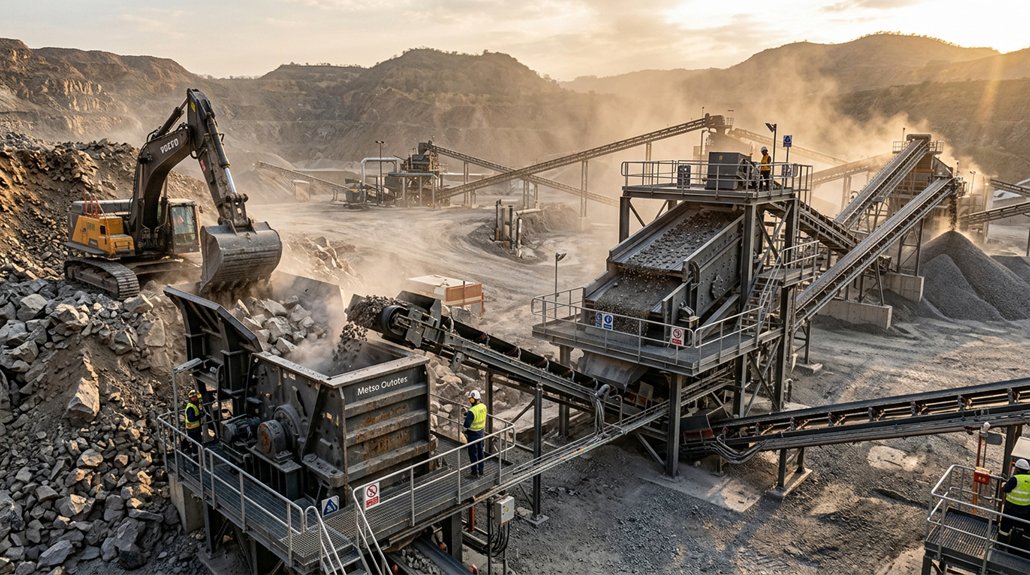
Advanced crushing and screening systems help you produce consistent aggregate with less waste, energy, and downtime. Match jaw, cone, or impact crushers to your feed, then calibrate screen apertures and settings to hit target gradations. Integrated sensors and plant controls adjust equipment in real time, reduce unnecessary recirculation, and flag developing faults. You’ll improve throughput without sacrificing product quality. The sections ahead show how to select, optimize, and upgrade these technologies for your operation.
Key Takeaways
- Integrated crushers, screens, sensors, and plant controls stabilize throughput and maintain consistent product specifications.
- Choosing equipment and settings for the material improves particle shape, sizing accuracy, and production efficiency.
- Optimized screening reduces oversize recirculation, equipment wear, energy use, and dust.
- Real-time monitoring and predictive maintenance identify problems early, reducing breakdowns and downtime.
- Data-driven upgrades, operator training, and environmental controls support safer, more sustainable aggregate production.
See How Crushers and Screens Work Together

Crushers reduce feed material to target sizes, while screens separate each output by particle size and return oversize material for further crushing. This closed-loop process lets you control gradation continuously: screens pass on-spec particles to stockpiles and route oversized pieces back to the crusher.
You’ll see how coordinated belt speeds, screen angles, and crusher discharge rates keep material moving without bottlenecks. Sensors can track load and particle flow, helping operators adjust settings before quality drifts or equipment overloads.
Effective Material sorting also limits unnecessary recirculation, reducing wear and energy use across the circuit. Enclosures and targeted Dust suppression systems capture airborne fines at transfer points, improving visibility and protecting workers.
With each stage communicating clearly, you can maintain consistent output and respond quickly to changing feed conditions throughout production.
Match Crusher Types to Feed and Product Goals
Once your screening circuit defines the target gradation, choose a crusher that suits both the incoming feed and the product you need. Match jaw crushers to primary reduction of large, abrasive rock; their robust design handles variable feed sizes.
For high-throughput secondary stages, consider cone crushers, which process hard, competent material into controlled sizes. If your feed is softer or less abrasive, an impact crusher can deliver a cubical product with fewer stages.
Assess Material hardness, abrasiveness, moisture, and maximum lump size before selecting equipment; these properties shape wear rates, capacity, and energy demand. Then set Crusher calibration to align the closed-side setting and rotor speed with your target output.
Monitor power draw and product samples as conditions change. A well-matched crusher reduces recirculation, protects components, and keeps production aligned with your specification.
Choose Screens for Consistent Aggregate Quality
How do you keep every product stream within specification? Choose a screen deck that matches your target gradations, feed characteristics, and required throughput. Aperture shape and size control particle passage; deck area and inclination influence capacity and retention time. When you balance these factors, you limit misplaced material without sacrificing production.
Prioritise Screen calibration to maintain accurate cuts. Check aperture wear, tension, and deck condition regularly, since damaged panels can shift sizing and contaminate finished products. Select media suited to your material: wire cloth offers open area, while polyurethane or rubber can improve wear life in abrasive service.
Manage feed distribution to prevent overloaded zones and support consistent Material segregation. Pair each screen with suitable discharge chutes and stockpile handling, preserving separation between fractions. Verify gradations through representative sampling and adjust screen setup when results drift.
You’ll deliver dependable aggregate quality across changing feed conditions.
Use Automation to Keep Crushing on Track
When feed rates, crusher settings, or equipment loads shift, automation helps you respond before production drifts off target. Sensors track material flow, motor load, and vibration, while control systems adjust feeder speed and crusher parameters in real time. You can use these signals to stabilise throughput, maintain product specifications, and identify developing faults before they cause unplanned stops.
Integrated dashboards give operators a clear view of equipment status and alert them to abnormal conditions. Remote controls also let you coordinate crushers and conveyors without relying on constant manual adjustments.
Automation works best when your team understands both the system and its limits. Provide operator training on alarms, overrides, and fault response, and enforce safety protocols during inspections and maintenance.
With skilled oversight, automated crushing stays controlled, predictable, and productive.
Cut Energy Use and Waste in Aggregate Processing
Because crushing, screening, and conveying consume substantial power, small efficiency gains can reduce both operating costs and emissions. You can target those gains by matching crusher settings to feed characteristics and using variable-speed drives to limit unnecessary power draw.
Modern screening systems separate material precisely, so you can return only correctly sized particles for further crushing instead of repeatedly processing usable product. This supports energy efficiency while reducing wear on equipment.
You can also improve waste reduction by monitoring moisture, adjusting screen media, and capturing fines that would otherwise leave the process as discard. Integrated sensors reveal energy-intensive bottlenecks and material losses, helping you refine operating parameters before costs accumulate.
When you combine efficient equipment with continuous condition monitoring, you’ll use less fuel and electricity, recover more saleable material, and lower the environmental footprint of each tonne produced.
Increase Throughput Without Losing Consistency
The same process controls that cut energy use can raise throughput without compromising product consistency. When you coordinate crusher settings, screen apertures, and feed rates, you can move more material through each stage while maintaining target gradations. Advanced screening separates particles accurately at higher loads, while adaptive crushing limits excess fines and recirculation.
You’ll get the best results by matching equipment capacity to the material’s characteristics and adjusting settings as feed conditions change.
Consistent Material blending also helps stabilise the feed, reducing fluctuations that can disrupt sizing and product quality. Use representative sampling and clear operating limits to verify that each output meets specification.
Strong Quality assurance links these checks to practical adjustments, so you can sustain production gains without accepting variable aggregate. This approach delivers dependable volumes for demanding applications.
Use Plant Data to Prevent Equipment Downtime
By turning plant data into early warnings, you can address equipment problems before they halt production. Sensors on crushers, screens, conveyors, and bearings track vibration, temperature, pressure, and motor current.
Data analytics can combine these signals with operating conditions to reveal abnormal patterns, such as rising bearing temperatures or changes in screen vibration.
You can use these insights to schedule predictive maintenance before a component fails, rather than relying on fixed service intervals or reacting to breakdowns. Set thresholds for critical assets, route alerts to operators, and link each warning to an inspection or maintenance task.
Reviewing fault histories helps you refine alerts and distinguish genuine deterioration from normal process variation. With timely, actionable information, you can reduce unplanned stoppages, protect equipment, and keep production more dependable across changing operating conditions.
Plan an Upgrade That Fits Your Aggregate Operation
Once data-driven maintenance improves reliability, assess where an upgrade will deliver the greatest operational gain. Map bottlenecks across your crushing, screening, and conveying circuits, then compare actual throughput with target production and product specifications. Identify whether worn components, poor feed control, or undersized screens limit performance.
Choose equipment that fits your material, site footprint, and future demand. Advanced crushers and screens can improve particle shape, increase separation accuracy, and reduce recirculation. Integrate controls with your plant data system so operators can adjust settings quickly and track results.
Review Material handling before installation: safer, shorter transfer routes can cut spillage and wear. Evaluate energy use, water demand, dust controls, and noise to understand environmental impact. Phase commissioning around production schedules, train crews, and verify gains against baseline metrics. You’ll achieve a practical upgrade without disrupting reliable operations.
Conclusion
When you connect crushers, screens, automation, and plant data, you turn processing into a coordinated system—not a collection of machines. Match each stage to your feed and product goals, then track energy, throughput, quality, and wear. You’ll spot bottlenecks sooner, reduce waste, and plan upgrades around real operating needs. Think of your plant as a modern assembly line guided by a medieval astrolabe: every signal helps you steer. Start with one measurable improvement, then build from there.
Leave a Reply