
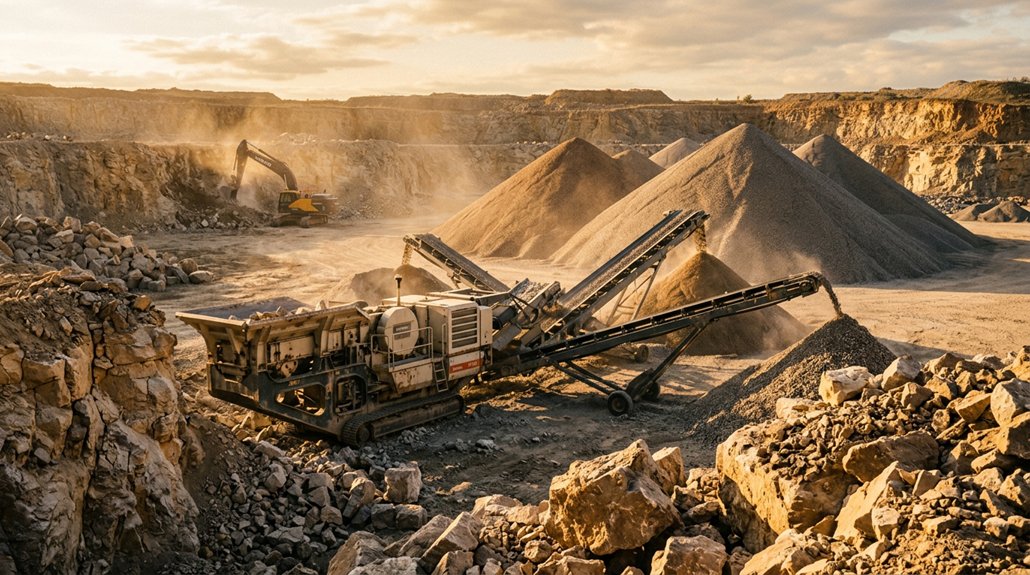
Aggregate production starts when geologists assess a deposit for rock quality, volume, access, and environmental constraints. Engineers then drill and carefully blast the rock, controlling fragment size, vibration, and flyrock. Haul trucks carry the broken material to crushers, where staged crushing and vibrating screens sort it into specified sizes. Washing removes clay and silt, while sampling checks gradation, moisture, cleanliness, and durability. You’ll see how careful dispatch and transport deliver verified aggregate ready for construction.
Key Takeaways
- Geologists assess deposits for rock quality, volume, access, environmental risks, and suitability for construction.
- Engineers drill and carefully blast rock into manageable fragments while controlling vibration, flyrock, and other hazards.
- Haul trucks deliver fragments to crushers, where crushing and screening produce specified aggregate sizes.
- Washing removes clay and silt; sampling checks gradation, cleanliness, moisture, shape, and durability.
- Finished aggregate is stockpiled, documented, and dispatched by truck, rail, or barge for accurate delivery to projects.
Where Aggregate Production Begins

Aggregate production begins at the deposit, where geologists and engineers assess the rock or sand for quality, volume, and access. You’ll see them map strata, sample materials, and test properties such as strength, gradation, and durability. These measurements help you match a deposit to concrete, road base, drainage, or other specifications before investing in extraction.
You’ll also evaluate land ownership, transport links, water availability, and nearby communities. Environmental impact studies identify sensitive habitats, groundwater risks, dust pathways, and restoration needs; permits set limits and monitoring requirements.
Historical development can reveal former workings, access routes, and local land-use patterns, helping you understand constraints and opportunities. With geological data, market demand, and regulatory conditions aligned, you can determine whether the site supports a viable operation and plan its footprint responsibly.
This groundwork guides decisions before production equipment arrives.
How Quarry Rock Is Drilled and Blasted?
You map the rock face and drill blast holes to a designed depth, spacing, and pattern.
Then you load each hole with explosives and connect the initiation system.
When you detonate the charge, timed energy fractures the rock into material sized for processing.
Drilling Blast Holes
How does a quarry turn solid rock into manageable pieces? It begins with a precise pattern of blast holes. Before drilling, you’ll see engineers map the rock face, assess its structure, and set hole locations, spacing, depth, and angle. These measurements shape how the rock will break while limiting unwanted vibration and oversized fragments.
Drilling techniques match the geology and production plan. A rotary or down-the-hole rig advances a steel bit through hard rock, while operators monitor alignment, penetration, and depth. Each hole must follow its design; deviations can disrupt the intended break.
You’ll also notice dust suppression, equipment checks, and controlled access around the drilling area. Blast safety starts here: crews inspect the bench, communicate hazards, and keep people clear of active work zones. The finished holes prepare the rock for the next stage.
Loading and Detonating
Once drilling is complete and the blast area is cleared, trained shotfirers load each hole with a planned charge of explosive and fit a detonator. They follow the Blast design, which sets charge weight, loading depth, and initiation sequence to break rock efficiently while controlling vibration and flyrock.
You’ll see crews check hole conditions, place stemming above the charge, and connect detonators according to the firing plan. Explosive safety governs every step: authorized personnel handle explosives, maintain exclusion zones, and verify communications before firing.
After a final inspection, the shotfirer initiates the sequence remotely from a protected location. The timed detonation fractures the rock along planned lines, producing fragments suited to processing.
Crews then wait for fumes to clear and inspect the face before allowing equipment to return.
From Blasted Rock to the Crusher
Controlled blasting fractures the rock into fragments sized for efficient handling while preserving crusher throughput.
You’ll assess the muck pile for oversize pieces and manage them before loading.
Haul trucks then carry the blasted rock to the crusher, where feed rate and fragment size shape the next stage of production.
Controlled Rock Blasting
When the blast breaks the rock, its results shape every step that follows. You’ll see controlled blasting begin long before detonation, with engineers mapping the bench, measuring rock structure, and designing precise hole patterns. They calculate burden, spacing, depth, and charge timing to fracture the face efficiently while limiting vibration, flyrock, and excessive fines.
Your crew follows Explosive safety procedures and Blasting regulations at every stage, from handling charges to clearing and securing the blast zone. Electronic detonators can sequence charges in milliseconds, steering energy through the rock rather than wasting it.
After detonation, specialists inspect the face and assess fragment size, stability, and remaining hazards. That feedback informs the next design. By controlling fragmentation at its source, you help create consistent feed for the crusher and reduce avoidable wear, without compromising worker or site safety.
Hauling to the Crusher
After the blast, haul trucks move fragmented rock from the loading area to the crusher, linking pit operations to processing. You’ll see operators match truck size to excavator capacity, fragmentation, and haul-road conditions to keep loading balanced and reduce idle time.
Dispatch systems coordinate routes, queue positions, and crusher feed, turning transport logistics into a continuous, measurable flow. Before each trip, drivers check tire condition, payload, and road visibility; overloaded trucks strain equipment and slow cycles.
Well-maintained roads, controlled grades, and safe passing zones protect crews while limiting fuel use. You can reduce environmental impact by minimizing empty travel, managing dust with targeted watering, and maintaining engines to curb emissions.
At the crusher, trucks tip into a receiving hopper, where grizzly bars screen oversized pieces and regulate the next stage of processing.
How Crushing and Screening Sort Aggregate?
Crushing reduces blasted rock to usable sizes, while screening separates those pieces by dimension. At the primary crusher, you feed hauled rock between powerful jaws or onto a rotating impactor. The machine fractures oversized material, and you send the output to secondary crushers when a finer product is needed. Each stage targets a specific size range, so you can match aggregate to its intended use.
Next, vibrating screens move material across decks fitted with openings of chosen dimensions. Smaller particles pass through; larger pieces travel onward for further crushing or another screening pass. These sorting techniques create distinct size fractions without mixing them back together.
With equipment calibration, you adjust crusher settings, screen angles, and vibration rates to control throughput and gradation. You can route each fraction to a separate stockpile for later use.
How Washing and Quality Checks Prepare Aggregate?
Once screening separates the size fractions, washing removes clay, silt, and other coatings that can weaken aggregate performance or disrupt mix proportions. You’ll see water sprays and scrubbers release these contaminants, while screens and settling systems separate solids from wash water.
Plants often recirculate clarified water, reducing freshwater demand and environmental impact. They may also apply recycling techniques to recover usable fines from settled material, returning them to suitable product streams.
Quality checks then confirm each fraction meets its intended specification. Technicians sample aggregate and test particle size, shape, cleanliness, moisture, and durability.
They compare results with project requirements, adjusting screens or wash settings when readings fall outside limits. This feedback loop helps you achieve consistent grading and reliable bonding in concrete or asphalt.
Only verified material advances to the next production stage.
How Aggregate Gets to Construction Sites?
Verified aggregate moves from the plant to construction sites by truck, rail, or barge, depending on distance, volume, and access. You’ll typically receive truckloads for short hauls and flexible delivery, while rail or barge can move larger volumes efficiently over longer routes.
Dispatchers coordinate load size, delivery windows, and site access to prevent delays and avoid overloading stockpiles. At the destination, crews direct vehicles to designated unloading zones, where loaders or conveyors place material near the point of use.
Your logistics plan also shapes Environmental impact. Consolidating loads, selecting efficient routes, and using rail or water transport where practical can reduce fuel use and emissions.
Some projects source reclaimed aggregate nearby, linking transport choices with Recycling processes. Confirm gradation, moisture, and quantity against delivery records before placement; this keeps the material traceable and helps your crew maintain consistent performance across the worksite.
Conclusion
From the first blast to the final quality check, aggregate production turns solid rock into the materials that build your world. You’ve followed each step: drilling, crushing, screening, washing, and delivery. Every stage shapes stone to meet a project’s needs, like a carefully tuned instrument finding its note. When aggregate reaches your site, it’s ready to support roads, foundations, and structures—reliable building blocks with a journey as engineered as the places they help create.
Leave a Reply