
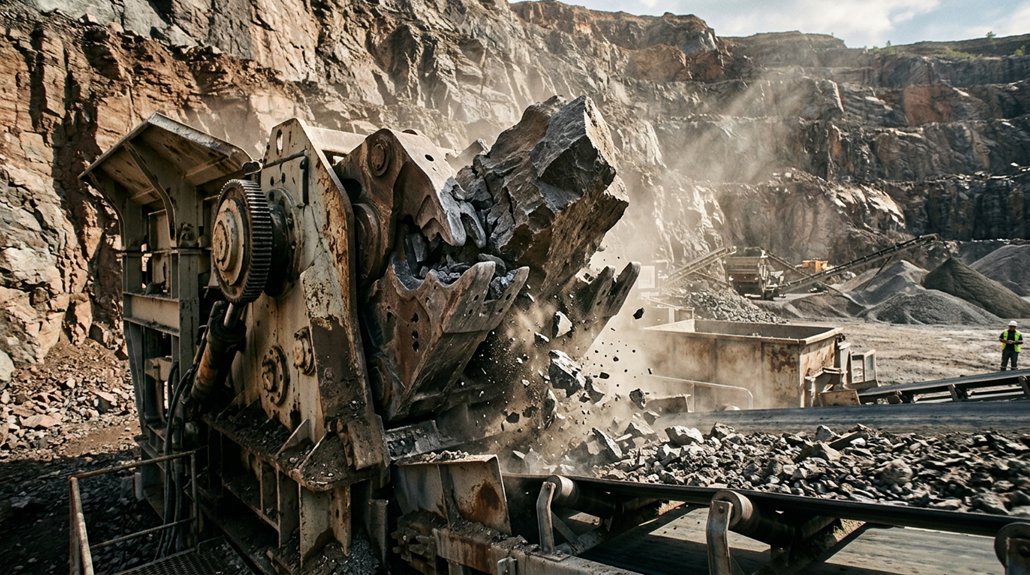
You turn massive quarry boulders into valuable aggregates through a measured sequence of breaking, crushing, screening, and washing. Controlled blasts loosen the rock; hydraulic breakers chip oversized chunks before primary crushers crack them with hardened jaws or cones. Secondary machines refine size and shape as vibrating screens sort each grade, sending oversize pieces back for another pass. Water washes away dust and clay. The result is clean, graded stone, and the stages ahead reveal how each choice shapes the final material.
Key Takeaways
- Controlled blasting loosens bedrock, while hydraulic breakers reduce oversized boulders to pieces crushers can handle.
- Primary crushers use jaws, cones, or impactors to fracture rock into smaller fragments.
- Secondary crushers refine fragment size and shape, with settings adjusted for product needs and equipment wear.
- Vibrating screens separate aggregates by size, returning oversized pieces for further crushing; washing removes dust, clay, and fines.
- Safety checks, dust controls, and recirculated wash water support reliable, responsible production.
How Quarry Crushers Break Down Rock
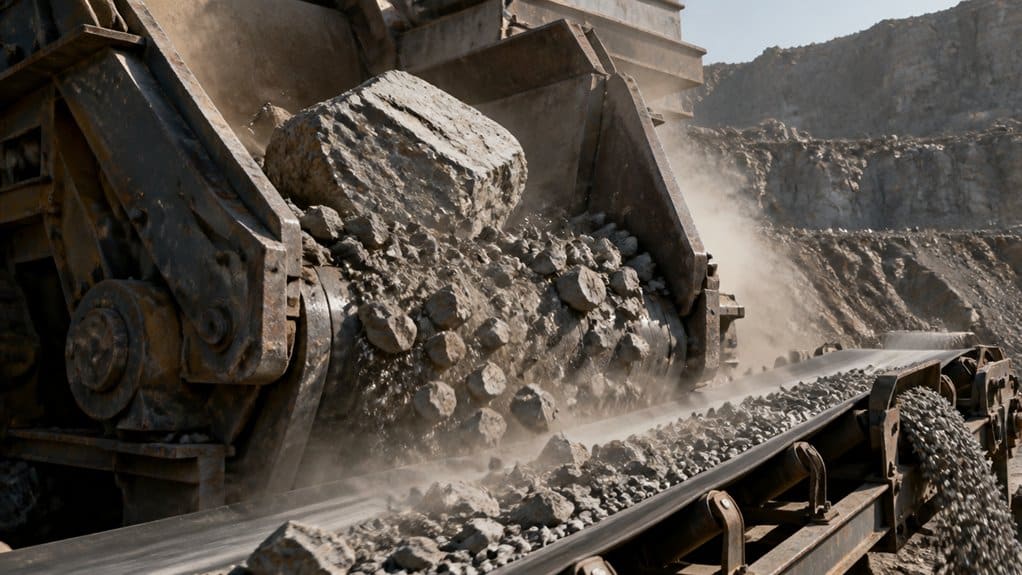
Quarry crushers turn solid rock into usable aggregate by applying controlled force at each stage. Inside the chamber, hardened jaws, cones, or impactors press and fracture stone, turning jagged faces into smaller, more uniform pieces. You can hear the change: a deep rumble sharpens into a steady crackle as fragments tumble through the machine.
Each crusher suits a different task. Jaw units squeeze large pieces between fixed and moving plates. Cone crushers compress rock in a narrowing gap. Impactors strike stone with fast-moving bars. Together, these mechanisms shape particle size and texture without treating every rock alike.
Rock durability affects how readily material fractures, while Crushing efficiency depends on matching crusher settings and design to the feed. You gain consistent aggregate when force, chamber geometry, and material properties work in concert.
How Blasting and Primary Crushing Begin
You’ll hear controlled blasts crack the rock face into manageable blocks. Crews reduce oversized boulders before they reach the crusher.
Then you’ll see the primary crusher grip and fracture each load into smaller stone.
Controlled Rock Blasting
Before quarry rock reaches a crusher, controlled blasting breaks the solid face into manageable fragments. You’ll see crews map the bench, drill measured holes, and load each with carefully calculated charges.
Their timing shapes Rock fragmentation: brief, sequenced detonations send a low thunder through the ground, loosening stone while limiting flyrock and vibration. Skilled operators adapt Blasting techniques to the rock’s strength, natural fractures, and nearby structures.
They use stemming to confine energy and precise delays to guide how cracks spread. From a safe vantage, you’ll watch dust rise as the face settles into a broken pile.
The blast isn’t a blunt strike; it’s a planned release of stored force. Surveyors then inspect the muck pile and confirm it’s safe for loading and transport to the primary crusher.
Boulder Size Reduction
Once the blast is cleared, loaders carry the broken rock to the primary crusher, where oversized boulders can’t enter the feed opening. You’ll spot the problem in their jagged silhouettes: some blocks still dwarf the opening, while others arrive cracked and ready.
Crews use a hydraulic breaker to chip down those outliers, directing its steel point into natural seams. Each impact sends a sharp report through the quarry and releases smaller, manageable pieces. This careful Boulder fragmentation protects the feed area from bridging and keeps rock moving steadily toward processing.
You’ll also see Rock densification in the fractured mass, as loose fragments settle into tighter contact during handling. Operators watch the pile’s shape and size, removing stubborn oversize before it can stall the next stage.
Here, preparation turns blast debris into feedstock.
Primary Crusher Operation
With oversize boulders broken down, the primary crusher takes its first steady feed. Before blasting, you’ll map the rock face, clear the exclusion zone, and check the blast plan; controlled charges loosen stone without sending fragments beyond safe limits. Afterward, you’ll inspect the muck pile and remove any unstable slabs.
At the crusher, you’ll feed material evenly, watching the jaw bite and the conveyor carry each fractured load onward. The chamber’s steel surfaces hammer and squeeze rock into manageable pieces, while dust suppression keeps the air clearer. You’ll monitor motor load, vibration, and discharge size, adjusting feed rate when the machine strains or surges.
Regular equipment calibration helps sensors report accurately, so you can catch wear before it becomes a breakdown. Throughout each cycle, quarry safety depends on clear signals, guarded walkways, and disciplined communication.
How Secondary Crushers Reduce and Shape Rock
After primary crushing breaks quarry rock into manageable pieces, secondary crushers refine those chunks into the sizes and shapes a project needs. You’ll hear the steady thrum of a cone crusher as its rotating mantle presses stone against a fixed bowl, shaving edges and reducing dimensions.
An impact crusher instead hurls rock against hard surfaces, fracturing it into sharper, more angular pieces. Choose the method to suit your material and the aggregate’s intended use: compressive force handles tough, abrasive stone, while impact action can produce a more cubical profile.
This secondary shaping gives you greater control over particle size and form. With rock refinement, you turn uneven fragments into consistent material for concrete, road base, or other construction needs.
Adjust crusher settings to balance output size, throughput, and wear without sacrificing the machine’s performance.
How Screening and Washing Grade Aggregates
As crushed rock rattles across vibrating screens, openings sort it into precise size bands for different jobs. You can watch each deck separate coarse stone from finer grains, while adjustable mesh keeps the cut consistent. Oversized pieces return for further crushing; correctly sized aggregate moves onward.
Washing adds another layer of control. Water jets loosen clay, dust, and stubborn fines, then screens drain the clean stone. You get aggregate with a more predictable texture and fewer contaminants, ready for concrete, road base, or drainage.
Settling ponds capture suspended sediment, and recirculation lets you reuse process water. When recovered fines or suitable Recycled materials enter the blend, you can conserve resources without compromising grading.
Careful handling also supports Eco friendly disposal of wash residue, keeping useful material in circulation and reducing waste around the quarry.
How to Choose Quarry Crushers for Your Rock
To choose the right quarry crusher, start with the rock: hard, abrasive stone like granite demands a different machine than softer limestone. Match the crusher to your feed’s hardness, fracture pattern, and maximum size.
A jaw crusher bites large, jagged boulders; an impact crusher can shape softer stone into more uniform pieces. If you need tightly controlled sizing, consider a cone crusher for secondary reduction.
Check the required throughput, too: undersized equipment can bottleneck your line, while excess capacity wastes fuel.
Factor in equipment mobility. A track-mounted unit can follow changing faces, while a stationary plant suits a long-term site.
Compare power needs, noise, dust controls, and fuel use to reduce Environmental impact.
Finally, choose a configuration that fits your haul routes, production goals, and finished aggregate specifications—not just the biggest rock you’ll crush.
How to Maintain Quarry Crushers Safely
Before maintenance, lock out the crusher and confirm every moving part has stopped.
Inspect liners, belts, and other wear components for cracks, thinning, or frayed edges.
Follow site safety procedures, keeping your hands clear and your protective gear on.
Lockout Before Maintenance
A crusher can look still while stored energy keeps its jaws, belts, or flywheels dangerous. Before maintenance, you must stop the machine and isolate every energy source, including electrical, hydraulic, pneumatic, and gravity-fed systems.
Follow your site’s lockout procedures: apply your personal lock and tag at each disconnect, then keep the key with you. Don’t trust a dark control panel; stored pressure or a suspended component can still move without warning.
Use safety protocols to verify isolation. Try the normal start control from a safe position, then return it to off. Check gauges and release or secure stored energy only as your training directs.
Tell nearby workers that the crusher is locked out, and never remove another person’s lock. When work ends, clear tools, confirm everyone stands clear, and restore power through your site’s authorized process.
Inspect Wear Components
Once lockout is verified, inspect wear parts for cracks, thinning, loose fasteners, or uneven surfaces. Use a bright light to examine jaw plates, liners, blow bars, and screen media; look for fresh metal, chipped edges, or grooves that catch your fingernail.
Compare each part with its wear limits and the manufacturer’s specifications. Don’t rely on appearance alone: measure thickness at several points, since uneven wear can signal misalignment or changing feed conditions.
Check fasteners for movement, and note any unusual marks before they disappear beneath dust. Record your findings, locations, measurements, and dates in the maintenance log.
This Wear component inspection helps you plan replacements before a failure interrupts production. Consistent records also reveal wear patterns, extend equipment lifecycle, and support timely parts ordering without guesswork or unnecessary replacements.
Follow Safe Procedures
With wear checks complete, keep the crusher secured until every maintenance task is finished. Lock out and tag every power source, then test controls to confirm the jaws, belts, and feeders can’t move.
Release stored hydraulic pressure and block raised components with rated supports; never trust a switch or jack alone.
Wear a hard hat, eye protection, gloves, hearing protection, and a respirator suited to the dust.
Use approved tools, maintain clear escape routes, and keep a spotter nearby when lifting heavy parts.
Follow the manufacturer’s service sequence, especially when equipment customization changes guards, access points, or isolation needs.
Control dust and spills to limit Environmental impact.
Before restarting, remove tools, replace guards, clear personnel, and warn the crew.
Restore power only after you’ve verified every safeguard and signed off the work.
Conclusion
You’ve watched a quarry turn stubborn boulders into clean, graded aggregates: blasting starts the argument, crushers settle it, and screens sort the evidence. Choose machines for your rock, capacity, and product goals, then maintain them before dust, heat, and vibration stage a revolt. Treat safety as essential, not decorative paperwork. Otherwise, your crusher may deliver a dramatic performance—at the worst possible moment. With smart choices and steady care, you’ll turn stone into value, not expensive confetti.
Leave a Reply